Et si vous pouviez vous laisser porter?
Il y a des moments où je prends conscience de toute l'énergie que nous dépensons à nous tenir.
À anticiper. À prendre soin des autres. À essayer de prendre les bonnes décisions. À garder le cap. À nous assurer que tout continue d'avancer.
Nous devenons tellement habitués à être celle ou celui qui tient tout ensemble que nous ne remarquons parfois même plus l'effort que cela demande.
Et sous tous ces efforts, il y a parfois un désir plus silencieux.
Et si vous pouviez, pour un instant, vous laisser porter?
Pas nécessairement par une autre personne.
Par la vie elle-même.
Sentir qu'il y a quelque chose sous vous. Quelque chose de stable. Une présence sur laquelle vous pouvez vous déposer.
C'est peut-être pour cette raison qu'Uli est revenue si fortement dans mon esprit ces derniers temps.
La Grande Mère en nous
J'ai rencontré Uli il y a plusieurs années à Kauai, auprès de mon enseignante Laura Kealoha Yardley.
Dans la tradition du Huna lémurien qui m'a été transmise, Uli est la...
What If You Could Let Yourself Be Held?
There are times when I notice how much energy we spend holding ourselves together.
Managing what needs to happen next. Anticipating. Taking care of others. Trying to make the right decision. Keeping things moving.
We become so accustomed to being the one who holds everything that we may not even notice how much effort it requires.
And beneath all of that effort, there can be a quieter longing.
What would it feel like to be held?
Not necessarily by another person, but by life itself.
To soften the part of us that believes we have to manage everything on our own and feel, even for a moment, that there is something underneath us. Something steady. Something we can lean back into.
This is one of the reasons I have been thinking about Uli lately.
The Great Mother within
I was introduced to Uli many years ago through my teacher, Laura Kealoha Yardley, on Kauai.
In the Lemurian Huna tradition I was taught, Uli is the Great Mother. She is associated with the Earth and with the qualit...
Whenever I Think of Laka, I Think of Water

I’ve often wondered why certain places make it easier to hear ourselves.
For me, it has always been the ocean.
Whenever life feels especially full, I find myself walking along the shoreline. I don’t usually arrive with the intention of figuring something out. I simply walk. Somewhere between the sound of the waves and the rhythm of my own breathing, the conversation in my mind becomes quieter. I begin to notice things I couldn’t hear before.
It has taken me years to trust those moments.
When I was younger, I believed that understanding came from thinking. Today, I find that some of the deepest understandings in my life have arrived while I was paying attention to something entirely ordinary.
The ocean has been one of those teachers. Perhaps that is why, whenever I think of Laka, I think of water.
More than twenty years ago, I travelled to the Hawaiian island of Kauai, where I met my teacher, Laura Kealoha Yardley. She introduced me to the teachings of Lemurian Huna, although I do...
Chaque fois que je pense à Laka, je pense à l'eau
Dernièrement, je pense souvent à l’eau.
Je ne sais pas pourquoi.
Peut-être parce que nous sommes au cœur de l’été. Peut-être parce que, lorsque la vie devient plus exigeante, c’est toujours vers l’océan que je me tourne.
Je n’y vais jamais avec l’idée de trouver une réponse.
J’y vais parce que quelque chose en moi sait que j’ai besoin d’y être.
Je marche.
Je regarde l’eau.
Et, sans que je puisse dire exactement à quel moment cela se produit, je repars différente. Simplement un peu plus proche de moi-même.
C’est une expérience que je vis depuis des années, mais je crois que je commence seulement à comprendre pourquoi.
Lorsque j’ai rencontré Laura Kealoha Yardley, à Kauai, il y a plus de vingt ans, elle parlait souvent de Laka.
À cette époque, je connaissais très peu le Huna lémurien. J’écoutais davantage avec mon cœur qu’avec ma tête.
Je ne cherchais pas à tout comprendre. Je laissais les enseignements me traverser.
Avec le temps, j’ai réalisé que c’était peut-être la me
...The Three Selves of Huna: Returning to the Wisdom Within
More than twenty years ago, I encountered the Hawaiian teachings of Huna, and something in me immediately recognized their truth.
One of the reasons I fell in love with Huna was that it offered a way of understanding ourselves that felt deeply aligned with my own experience.
We are not meant to live from the mind alone.
Our intellect is brilliant. It can analyze, plan, imagine, and make meaning of our experiences. It helps us make decisions, solve problems, and navigate our lives.
But there is another kind of intelligence available to us.
One that doesn't think in words or logic.
It feels.
It senses.
It knows.
One of the foundational teachings of Huna is the concept of the Three Selves. The ancient Hawaiians understood us as having three aspects of self that are all essential and all sacred.
Transformation happens not by suppressing one of them, but by bringing them into relationship and harmony.
The Uhane: The Conscious Mind
The uhane is our conscious mind.
It is our in
...What Has Never Changed in You

When Everything Changes… What Remains?
There is so much that changes in a life.
Thoughts come and go.
Emotions rise and fall.
Relationships evolve.
The way we see ourselves shifts over time.
Even the identity we once held so tightly can soften… or fall away.
And yet, beneath all of this movement, something in you has never moved.
Not as an idea.
Not as a belief.
But as a direct, lived experience.
A quiet presence.
A simple knowing:
I am.
Before Meaning… There Is Presence
On the spiritual path, we often ask:
What is the meaning of my life?
What is truly aligned for me now?
These are important questions.
Because at a certain point, we begin to realize that meaning is not something we find “out there,” but something we participate in creating—through our attention, our choices, and the way we meet life.
But there is something even more foundational than meaning.
Something that exists before interpretation.
Before decision.
Before identity.
The simple, undeniable sense of bei...
Du réveil à l’éveil : revenir au corps pour vivre une vie plus vraie
Il y a des moments dans une vie…
où quelque chose bascule.
Parfois, c’est subtil.
Un léger décalage.
Comme si ce qui faisait sens avant… ne résonnait plus tout à fait de la même façon.
Et parfois, c’est plus brutal.
Un choc.
Une rupture.
Un événement qui nous réveille.
Ce qu’on appelle souvent… un réveil.
Mais le réveil, à lui seul, ne transforme pas une vie.
Ce qui transforme…
c’est ce qui vient après.
Du réveil… à l’éveil
Le réveil ouvre une porte.
L’éveil… est un choix.
Un choix de rester.
Un choix d’écouter.
Un choix de se rencontrer vraiment, au-delà des automatismes, des habitudes, des conditionnements.
Dans un récent épisode du balado Pulsion d’éveil, avec Jean-Marie, nous avons eu cette conversation avec France Gauthier.
Et ce qui est venu, encore une fois, très clairement, c’est ceci :
La transformation ne se fait pas dans la tête.
Elle se fait dans le corps.
Le langage du corps
Nous avons appris à penser.
À analyser.
À comprendre.
Mais très peu… à ressentir.
Et pourta...
Recevoir est plus difficile que donner
Donner est naturel pour beaucoup d’entre nous.
Nous avons appris à offrir, soutenir, anticiper, porter.
Donner nous garde en mouvement. Cela nous donne une forme de contrôle. Cela nous permet de rester en relation sans trop nous exposer.
Mais recevoir est différent.
Il y a un moment dans le corps où quelque chose nous est offert—
un compliment, du soutien, de l’attention—
et au lieu de s’ouvrir, quelque chose se referme légèrement.
Une petite contraction.
Une hésitation subtile.
Pas parce que nous ne voulons pas recevoir,
mais parce que, quelque part en nous, recevoir ne se sent pas complètement sécuritaire.
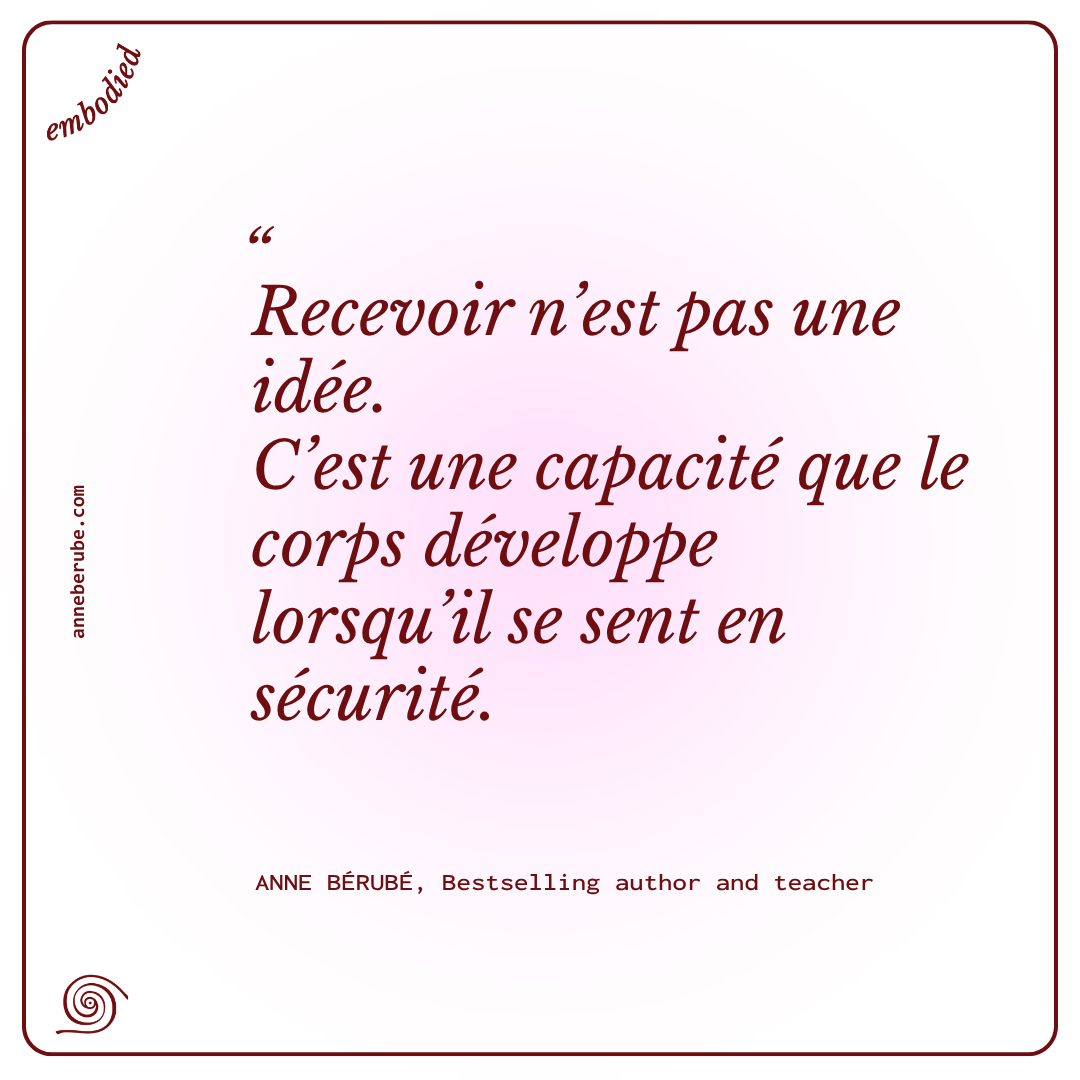
Recevoir n’est pas une idée.
C’est une capacité du système nerveux.
Si, dans nos premières expériences, nos besoins ont été perçus comme « trop », ou si l’amour était incertain ou conditionnel, le corps s’adapte. Il apprend à donner plutôt qu’à avoir besoin.
Avec le temps, donner devient familier.
Recevoir devient inconfortable.
—
C’est pourquoi recevoir ne peut pas être for...
Receiving Is Harder Than Giving
Giving comes naturally to many of us.
We’ve learned how to offer, support, anticipate, and hold.
Giving keeps us in motion. It keeps us in control. It allows us to stay in relationship without feeling too exposed.
But receiving is different.
There is a moment in the body when something is offered—
a compliment, support, care—
and instead of opening, something subtly pulls back.
A small tightening.
A quiet hesitation.
Not because we don’t want what’s being offered,
but because somewhere in the body, receiving doesn’t feel entirely safe.
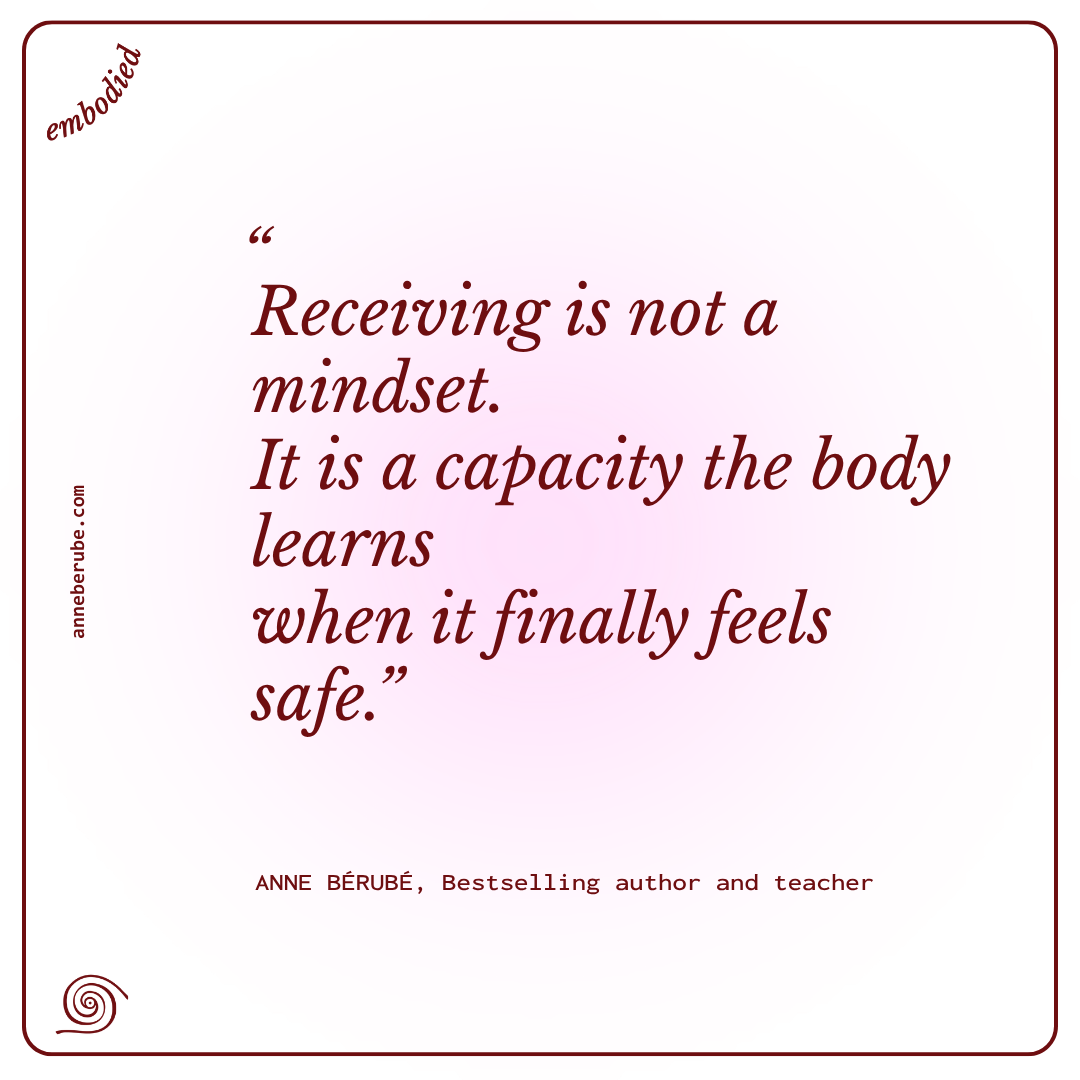
Receiving is not just a mindset.
It is a capacity of the nervous system.
If our early experiences taught us that our needs were too much, or that love was inconsistent or conditional, the body adapts. It learns to give rather than to need.
Over time, giving becomes familiar.
Receiving becomes uncomfortable.
—
This is why receiving cannot be forced.
It begins with safety.
In the body.
In the breath.
In the ability to slow down and stay present.
When Success No Longer Fits: Learning to Trust the Body During Life Transitions
There are moments in life when everything appears to be working.
From the outside, the path looks successful. The work is meaningful. The structure is clear. We know what we are doing each day and how to measure our progress.
And yet, something inside begins to shift.
Often, the first signals of that shift do not come as clear thoughts or decisions. They appear in the body.
Fatigue that doesn’t go away.
A loss of energy for things that once felt exciting.
A sense of tightness, restlessness, or misalignment that we cannot easily explain.
Before the mind understands what is changing, the body often already knows.
Recently on the Embodied podcast, I had a conversation with wellness entrepreneur and author Meghan Telpner about this exact experience. Meghan built a thriving nutrition and cooking school that served thousands of people over fifteen years. From the outside, her work was impactful, successful, and deeply respected.
And yet, over time, something in her began to change.
The...
